
If you run a news website with more than one or two reporters filing stories, you already know the chaos that can creep in without the right system. One reporter uploads a story without images, another forgets to add a category, someone publishes a breaking news update with a spelling mistake because there was no one to check it before it went live, and your editor is left chasing WhatsApp messages just to know what’s even ready for review. This is one of the most common problems Indian news portals run into as they grow from a one-person blog into a real newsroom with a team.
The good news is that this isn’t a people problem, it’s mostly a systems problem. With the right Content Management System, or CMS, and a few sensible workflows, managing five, fifteen, or even fifty reporters becomes genuinely manageable. This guide walks you through exactly how to do that, step by step, in plain and simple language.
Why Reporter Management Becomes Difficult as You Scale
When a news portal is run by just one or two people, everything works fine through informal communication. But the moment you add more reporters, a few things start breaking down naturally. Stories start missing quality checks because there’s no clear approval process. Duplicate stories get published because two reporters didn’t know the other was covering the same event.
Bylines and credits get mixed up, which hurts individual reporter accountability and reader trust. And perhaps most frustrating for the person running the portal, there’s no clear picture of who is actually contributing how much content, which makes it hard to manage performance or plan coverage.
None of these problems are unusual. They’re a natural part of growing any content operation. What separates a chaotic newsroom from a well-run one isn’t the number of reporters, it’s whether the underlying CMS is actually built to handle a multi-reporter team.
Also Read: Journalism and Mass Communication Courses After 12th
What “Managing Multiple Reporters” Actually Means in a CMS
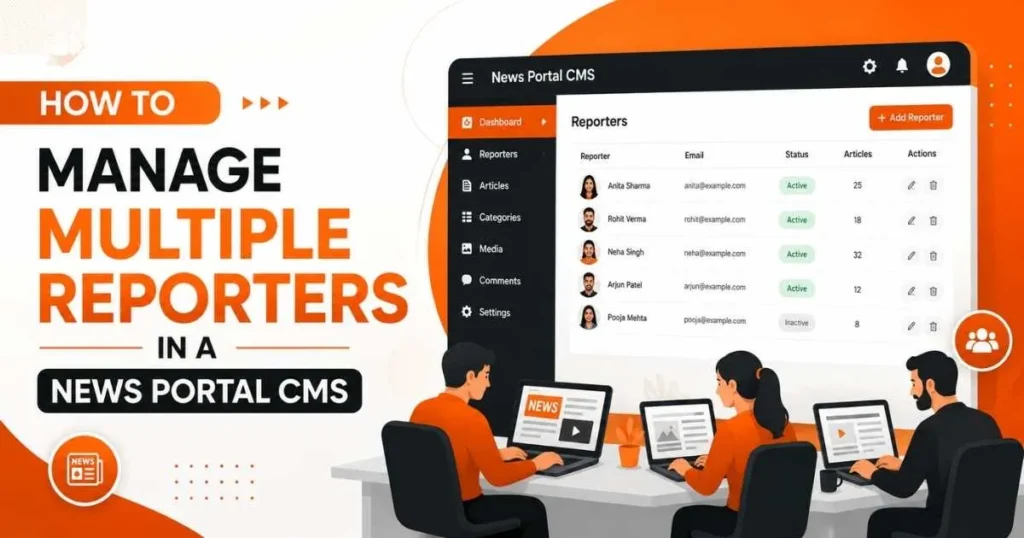
Before getting into the how, it helps to be clear on what this actually involves. Managing multiple reporters in a CMS covers a few connected things: giving each reporter their own login and clearly defined role, controlling what they can and cannot do on the backend, setting up a review and approval process before anything goes live, tracking who wrote what and when, and giving your editorial team enough visibility to manage the whole operation without constant back-and-forth messaging. Get these right, and your newsroom runs itself far more smoothly than you’d expect.
Role-Based Access Control: The Foundation of Everything
The single most important feature for managing multiple reporters is role-based access control, often shortened to RBAC. This simply means that not everyone who logs into your CMS should have the same level of access. A junior reporter shouldn’t be able to publish a story directly to your homepage without anyone checking it first, and an intern definitely shouldn’t be able to delete another reporter’s article by mistake.
A properly built news CMS typically offers several distinct roles. Reporters can write and submit stories, but their work goes into a “pending review” stage rather than going live immediately. Sub-editors or copy editors can review, edit, and approve stories submitted by reporters, checking for grammar, factual accuracy, and formatting before publishing.
Section editors or bureau heads can manage a specific category or city desk, overseeing a small team of reporters within that beat. And administrators, usually the owner or senior editorial staff, have full control over the entire portal, including user management, site settings, and final publishing authority.
Setting up these roles properly from day one avoids a huge number of headaches later. It also means that even if you have twenty reporters filing stories at once, nothing goes live without passing through the right checkpoints.
Setting Up an Editorial Approval Workflow
Once your roles are in place, the next piece is a clear approval workflow. This is essentially the journey a story takes from being written to being published. A typical, well-functioning workflow looks something like this: a reporter drafts a story and submits it for review, rather than hitting publish directly. A
sub-editor or the desk in charge reviews the draft, checks facts, fixes language issues, and either approves it or sends it back with comments for the reporter to fix. Once approved, the story either gets scheduled for a specific publishing time or goes live immediately, depending on how time-sensitive the news is.
This kind of structured workflow does two things at once. It maintains quality and accuracy across everything your portal publishes, which matters enormously for reader trust and for search engines that increasingly reward accurate, well-edited journalism. And it gives reporters clear expectations about their own process, so there’s no confusion about who is responsible for what at each stage.
Tracking Reporter Performance and Output
One thing that often gets overlooked in smaller news operations is performance tracking. A good multi-reporter CMS should let you see, at a glance, how many stories each reporter has filed in a given week or month, which of their stories performed well in terms of reader traffic, and how quickly they’re turning around breaking news versus routine coverage. This isn’t about micromanaging your team, it’s about having the visibility needed to make fair, informed decisions about workload distribution, incentives, and where additional hiring might be needed.
Many modern CMS platforms also let you set individual reporter profiles with author pages, which is genuinely good for two reasons. Readers get to know and follow specific reporters they trust, building loyalty to your brand through individual bylines. And your reporters get proper credit for their work, which is a small thing that makes a real difference to morale in a newsroom.
Managing Beats and Categories Without Overlap
A common issue in growing newsrooms is duplicate coverage, where two reporters end up covering the same event without realising it, wasting valuable reporting time and creating confusion. A well-organised CMS helps prevent this by letting you assign reporters to specific beats or categories, whether that’s politics, sports, local city news, or entertainment. When reporters and editors can see a shared assignment board or category-wise story pipeline within the CMS itself, this kind of duplication becomes far less common, and your coverage naturally becomes more comprehensive since different reporters are focused on different areas rather than accidentally competing for the same story.
Communication Tools Built Into the CMS
Relying purely on WhatsApp groups or personal phone calls to coordinate a newsroom might work for a very small team, but it quickly becomes unmanageable as you grow. A good CMS should have built-in communication features, such as internal comments on individual stories, so an editor can leave feedback directly where the reporter will see it, notification systems that alert reporters when their story has been approved, rejected, or needs edits, and a shared calendar or assignment board so everyone knows what’s being covered and when.
Keeping this communication inside the CMS itself, rather than scattered across five different messaging apps, keeps everything organised and searchable, which matters a lot when you need to look back at who said what during a breaking news situation.
Preventing Plagiarism and Maintaining Editorial Standards
With multiple reporters filing content regularly, maintaining consistent editorial standards becomes genuinely important, both for your credibility with readers and for how search engines evaluate your site. Many advanced news CMS platforms now include built-in plagiarism checking tools that flag content lifted from other sources before it gets published. This protects your portal from copyright issues and also reinforces a culture of original reporting among your team.
Alongside this, having style guide templates within the CMS, covering things like how to format headlines, how to attribute quotes, and how to handle corrections, helps every reporter’s work feel consistent with your brand’s voice, regardless of who wrote it.
Handling Breaking News With a Larger Team
Breaking news moments are exactly when a poorly organised multi-reporter setup falls apart the fastest. If ten reporters are covering the same fast-moving story, you need a system that supports rapid updates without chaos. This usually means having a lead reporter or desk editor coordinate the main story thread, while other reporters contribute updates that get merged into a single live-updating article rather than five separate competing versions.
A CMS built for this kind of collaborative, real-time editing, where multiple users can safely work on the same story without overwriting each other’s changes, is genuinely essential for any news portal that wants to compete on speed during major events.
Mobile Access for Reporters in the Field
A huge portion of ground reporting happens away from a desk, at press conferences, protests, sports events, and disaster sites. Your CMS needs to work well on mobile devices, letting reporters file stories, upload images, and even do basic edits directly from their phones. This single feature alone can dramatically speed up how quickly breaking news actually reaches your readers, since reporters no longer need to rush back to an office or wait to access a desktop computer before submitting their work.
Common Mistakes News Portals Make With Reporter Management
A few recurring mistakes show up again and again in growing Indian news portals. Giving every reporter full publishing access, without any review layer, is one of the most damaging, since it removes any quality check before content goes live. Not clearly defining beats leads to duplicate coverage and gaps in other areas that nobody is tracking.
Relying entirely on external messaging apps for editorial coordination creates a scattered, hard-to-track workflow that becomes unmanageable as the team grows. And underestimating the need for mobile-friendly reporting tools slows down field reporters at exactly the moments when speed matters most, during breaking news.
Avoiding these mistakes usually comes down to choosing a CMS that’s actually built with multi-reporter newsrooms in mind, rather than trying to force a basic single-author blogging platform to handle a growing editorial team.
How 7K Network Solves This for Growing News Portals
This is exactly the kind of problem 7K Network was built to solve. As a dedicated best news portal development company in India, with a branch office in Lucknow, 7K Network has powered more than 5,000 news portals across India, and reporter and editorial management is built directly into the platform rather than added on as an afterthought.
7K Network’s CMS comes with over 70 built-in features designed specifically for Indian newsrooms, including proper role-based access control for reporters, sub-editors, and administrators, a structured content approval workflow so nothing goes live without a review, individual reporter profiles and author pages that help build reader trust in your bylines, and mobile-friendly publishing tools so your field reporters can file stories directly from their phones during live events.
What makes this particularly practical for growing news businesses in India is the speed and affordability of getting started. 7K Network delivers a fully functional news portal within just 7 days, starting at a genuinely accessible ₹9,999, with free domain and hosting included, so you’re not stuck paying multiple separate vendors before you even publish your first story.
We also supports content publishing in 15+ languages, which matters enormously for regional and multilingual news operations covering diverse audiences across India. And because a newsroom can’t afford downtime, 7K Network backs every portal with 24/7 support, so technical issues never become the reason a breaking story misses its moment.
For news portal owners specifically looking to scale their editorial team without descending into WhatsApp-group chaos, And if your portal also needs help growing its organic reach once the editorial side is sorted, 7K Network specifically on SEO and organic growth for news and content platforms, giving you a genuinely complete solution from setup to scale, all under the leadership of founder and CEO Damandeep Singh.
A Simple Checklist Before You Choose a CMS
If you’re evaluating whether your current CMS, or a new one you’re considering, is genuinely ready to handle multiple reporters, run through this quick checklist. Does it support distinct user roles for reporters, editors, and administrators? Is there a built-in approval workflow before stories go live? Can you track individual reporter output and performance? Does it work smoothly on mobile devices for field reporting? And does it include tools like plagiarism checking and internal commenting to maintain editorial quality? If the answer to most of these is yes, you have a genuinely solid foundation for scaling your newsroom.
Final Thoughts
Managing multiple reporters doesn’t have to mean chaos, missed deadlines, or endless WhatsApp confusion. With the right CMS features in place, role-based access, a clear approval workflow, performance tracking, mobile publishing, and built-in communication tools, a growing newsroom can scale smoothly while actually improving the quality and consistency of what gets published.
If you’re building or upgrading a news portal in India and want a platform that handles all of this out of the box, 7K Network’s CMS is purpose-built for exactly this kind of growth, backed by fast delivery, genuine affordability, and round-the-clock support for when it matters most.
More to Explore:
FAQs
What is the biggest mistake news portals make when adding more reporters?
Giving every reporter direct publishing access without any editorial review layer is the most common and most damaging mistake, since it removes quality control before content reaches readers.
How many reporter roles should a news CMS support at minimum?
At minimum, a CMS should distinguish between reporters, editors who can approve content, and administrators with full site control, though larger newsrooms often benefit from additional roles like section or bureau editors.
Can a small news portal with just three or four reporters still benefit from role-based access?
Yes, setting up proper roles and an approval workflow early, even with a small team, builds good editorial habits that make it far easier to scale smoothly as your team grows.
Does 7K Network’s CMS support multiple regional languages for reporters?
Yes, 7K Network’s platform supports content publishing in 15 or more languages, making it well suited for regional and multilingual Indian news operations.
How quickly can a news portal with multi-reporter management be set up through 7K Network?
7K Network typically delivers a fully functional news portal within 7 days, starting at ₹9,999, with free domain and hosting included.