
If you have just finished class 12 and you are the kind of person who reads the news before breakfast, argues about current affairs at the dinner table, or just cannot stop asking “why” about everything happening around you, journalism might already be on your mind. The tricky part is not whether you are interested. It is figuring out which course actually gets you there, what it costs, what you will study, and what kind of job is waiting for you on the other side.
This guide breaks all of Journalism and Mass Communication Courses After 12th, based on how admissions and the media industry actually look going into the 2026-27 academic year.
What Journalism and Mass Communication Actually Covers
Journalism and mass communication is a much bigger field than most 12th-standard students realise. It is not only about reporting the news on television or writing for a newspaper. The umbrella covers print journalism, broadcast and television news, radio and podcasting, digital and online journalism, photojournalism, public relations, advertising, corporate communication, and increasingly, content creation for social media and video platforms. A student who enjoys writing might end up in reporting, while a student who enjoys visuals might end up in photojournalism or video production, all under the same broad degree.
Going into 2026, digital media is where most of the growth is happening. Online newsrooms, mobile journalism, video storytelling, and social-first reporting have become just as important as traditional print and TV, so most updated journalism courses now include digital-first modules alongside the classic reporting and editing fundamentals.
Who Can Apply: Eligibility After Class 12
The good news is that journalism courses are open to students from any stream. You do not need to have taken Humanities or Arts in school to apply. Science and Commerce students are equally eligible for undergraduate journalism programmes.
- Diploma programmes: Open to students from any stream who have passed class 12, usually with no strict minimum percentage
- Undergraduate degree (BA Journalism, BJMC, BA Mass Communication, BMM): Class 12 pass from a recognised board, typically with a minimum of 45 to 50 percent marks, though this varies by institute
- Postgraduate diplomas and degrees: Require a completed undergraduate degree, usually with at least 50 percent marks
Some universities and institutes also conduct their own entrance tests or group discussions and personal interviews as part of admission, especially for the more selective programmes, so it is worth checking each college’s specific process rather than assuming a single common exam covers all of them.
Top Journalism and Mass Communication Courses After 12th
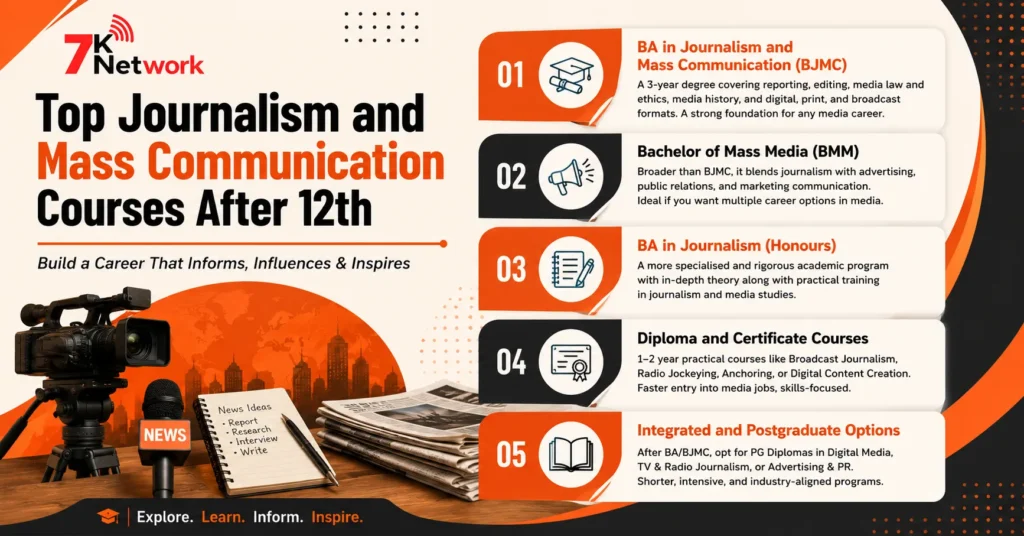
1. BA in Journalism and Mass Communication (BJMC)
This is the most common undergraduate route, typically a 3-year degree covering reporting, editing, media law and ethics, media history, and an introduction to digital, print, and broadcast formats. It is a good general foundation if you are not yet sure which specific media career you want.
2. Bachelor of Mass Media (BMM)
Offered mainly by universities in Maharashtra and a few other states, BMM is broader than BJMC, blending journalism with advertising, public relations, and marketing communication, useful if you want to keep your career options open beyond straight reporting.
3. BA in Journalism (Honours)
A more specialised, often more rigorous version of the BA route, usually offered by central and state universities, with a heavier academic and theoretical component alongside practical training.
4. Diploma and Certificate Courses
For students who want to start working sooner, 1 to 2 year diploma courses in Broadcast Journalism, Radio Jockeying, Anchoring, or Digital Content Creation are available right after class 12. These are more practical and skills-focused, and can be a faster route into an entry-level media job, though they generally do not replace a full degree for long-term career growth.
5. Integrated and Postgraduate Options
Students who complete a BA or BJMC often follow it with a PG Diploma in areas like Digital Media, TV and Radio Journalism, or Advertising and PR, which tend to be shorter, more intensive, and closely aligned with what newsrooms are actually hiring for right now.
What You Will Actually Study
Across most journalism and mass communication programmes, the core subjects usually include news writing and reporting, editing, media law and ethics, the history and structure of Indian and global media, photography and visual storytelling, and an introduction to advertising and public relations. Increasingly, courses also include dedicated modules on digital and mobile journalism, social media strategy, video editing, and search engine optimisation for online content, reflecting how much of the industry has shifted online.
Most reputable programmes also emphasise practical training. Expect newsroom simulations, internships with newspapers, TV channels, or digital news portals, and hands-on projects like producing a short documentary, running a mock news bulletin, or managing a live blog during a real event.
Where You Can Study: Types of Institutes
India has a wide spread of options for journalism education, ranging from central government-run institutes to private universities and standalone media colleges. Well-regarded names students commonly research include the Indian Institute of Mass Communication (IIMC) with campuses across several cities, Delhi University’s journalism programmes, Jamia Millia Islamia’s Mass Communication Research Centre, Symbiosis Institute of Media and Communication in Pune, Xavier Institute of Communications in Mumbai, and a growing number of private universities that have added dedicated media, mass communication & journalism colleges in recent years.
Entrance requirements, fees, and campus culture vary quite a bit between these, so it is worth shortlisting a few and comparing their course structure and placement record directly rather than going purely on brand name.
You Might Like to Explore: Top Journalism and Mass Communication Colleges in India
What the Career Path Actually Looks Like
A journalism and mass communication degree does not lock you into one single job title. Graduates typically move into reporting and news anchoring, editing and content production, digital journalism and content strategy for online news portals, public relations and corporate communication, advertising and brand content, video and multimedia production, and increasingly, independent content creation across YouTube, podcasts, and social platforms.
Salaries vary widely depending on the specific role, city, and organisation, but industry data places the average annual salary for the journalism and mass communication sector in the low double digits in lakhs, with clear room for growth as you move from entry-level reporting into editorial leadership, digital strategy, or corporate communication roles. India’s media and entertainment sector is projected to keep growing steadily through 2028, with digital platforms driving a large share of that growth, which is good news for anyone starting a media career now.
A Practical Note on Where Digital Journalism Is Headed
One thing worth understanding early: a growing share of journalism jobs today are not at a printed newspaper or a TV studio, they are at digital-first news portals and online newsrooms. These platforms need everything a traditional newsroom needs, reporters, editors, and content strategists, but they also depend heavily on the technology behind the website itself: how fast it loads, how well it is optimised for Google News and Discover, and how smoothly a newsroom can publish breaking stories.
At 7K Network, we build the technology side of that equation, developing news portals for publishers and independent journalists across India, so it is fair to say we sit right next to this industry every day. If you are a student who eventually wants to launch your own digital news platform rather than only writing for someone else’s, that technical foundation, a fast, SEO-ready, properly built news website, matters just as much as your reporting skills.
Quick Checklist Before You Apply
- Shortlist 4 to 5 institutes and compare their course structure, not just their brand name
- Check whether the programme has a strong digital and mobile journalism component, not just traditional print and TV modules
- Look at internship and placement support, since practical newsroom experience matters as much as classroom learning
- Confirm the entrance process early, some colleges require entrance tests, group discussions, or interviews
- Talk to current students or alumni if possible, to understand what the day-to-day coursework is really like
Skills That Matter More Than Your Degree Certificate
Recruiters in newsrooms and digital media companies consistently say the same thing: the degree gets you an interview, but a specific set of skills gets you the job. Strong written and spoken communication is non-negotiable, since every role in this field, from reporting to PR to content strategy, depends on being able to explain something clearly and quickly. Beyond that, curiosity and the discipline to verify facts before publishing matter more than ever in an environment full of misinformation.
On the practical side, basic comfort with digital tools has become almost as important as writing itself. That means knowing how to shoot and edit a short video on a phone, understanding how a story performs once it is published online, being comfortable with a content management system, and having at least a working sense of how search engines decide which stories to show first. Students who build these skills during their course, through internships, campus newsrooms, or personal blogging and video projects, tend to have a real edge when they start applying for jobs.
Fees and Duration: What to Roughly Expect
Costs vary a lot depending on whether you choose a government institute, a public university, or a private college. As a rough guide, diploma and certificate courses tend to run from a few months up to 2 years and are generally the most affordable option. Undergraduate degrees like BJMC or BA Mass Communication typically run 3 years at public universities and can be significantly more affordable than private institutes, which often charge considerably more per year but may offer better infrastructure, industry tie-ups, and placement support.
Postgraduate diplomas usually run 1 year and are priced somewhere between diploma and full degree programmes. Rather than picking based on cost alone, it is worth weighing fees against the quality of faculty, internship opportunities, and how current the curriculum is with 2026’s digital-first media landscape.
Final Thought
Journalism after 12th is one of the few career paths where curiosity itself is a genuine qualification. The course you choose will shape your first few years, but the field is broad enough that reporters, editors, PR professionals, and digital content strategists all start from a very similar foundation. Pick a course that gives you strong practical training and a real digital media component, and you will be well placed for where the industry is actually heading in 2026 and beyond.
FAQs
Do I need to have studied Arts or Humanities in school?
No. Journalism and mass communication courses accept students from Science, Commerce, and Arts backgrounds equally. What matters more is your interest in the field and your communication ability.
Is there a common entrance exam for journalism courses across India?
Not a single universal one. Some universities use their own entrance tests, some rely on interviews and group discussions, and some admit purely on your class 12 percentage. Always check the specific process for each institute you are shortlisting, since it can differ quite a bit.
Can I switch into digital journalism or content roles even if my course was mostly traditional?
Yes, easily. Most of the underlying skills, reporting, writing, fact-checking, and storytelling, transfer directly into digital and social-first roles. Many working journalists today started with a traditional print or broadcast-focused degree and picked up digital skills on the job.